
Teresa Sanhueza
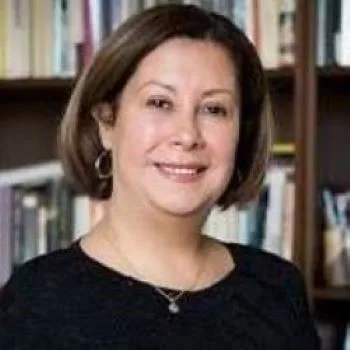
Teresa Sanhueza, Ph.D.
Associate Professor
336-758-5500
Greene 510
Latin American Theater
Dr. Maria Teresa Sanhueza is a philologist and Associate Professor of Spanish at Wake Forest University. She received her BA and MA from the Universidad de Concepción (Chile) and her PhD from the University of Michigan (Ann Arbor) and has held a visiting appointment at Oberlin College. Her research brings together Latin American theater, migration studies, and archival humanities, with a particular focus on the cultural and historical intersections between Italy and the Americas.
Her early scholarship was grounded in Latin American and Argentine theater, with a sustained interest in the dramatic representation of social conflict, migration, and cultural identity. Her book Continuidad, transformación y cambio: El grotesco criollo de Armando Discépolo (2004) remains a foundational study of Italian immigration and cultural hybridity in early twentieth-century Argentine theater and anticipates her later archival turn toward migration history and epistolary sources.
She has published widely on Latin American and Hispanic theater in peer-reviewed journals such as Latin American Theatre Review, Revista de Humanidades, Acta Literaria, Italian Americana, Revista de Estudios Hispánicos, INTI. Revista de Literatura Hispánica, Amoxtli, Revista Zibaldone, and Revista afuera, and is the author and editor of multiple scholarly volumes, including Ecos y estelas de un maestro: Homenaje a Mauricio Ostria González (2012) and Animales salvajes sueltos en mi mente (2016). Her current theater research continues alongside an active publication agenda, including forthcoming articles on contemporary Spanish and Latin American dramaturgy.
Over time, her work has expanded into a sustained interdisciplinary project on Italian migration to Argentina and the United States. This research develops from literary analysis into archival and field-based investigation centered on unpublished correspondence preserved by descendants of Italian emigrants. The project examines how migrants and their families used letter-writing as a medium for maintaining kinship ties, negotiating separation, and constructing transatlantic narratives of belonging.
Dr. Sanhueza’s research on Italian migration has been enriched by an NEH Summer Institute Fellowship at the University of Tampa (2023), where she studied the representation of Sicilian immigrants in Tampa’s teatro bufo and its connections to the Cuban-American communities of Ybor City. This work has expanded her focus on Italian migration to include the cultural intersections between Italian, Spanish, and Cuban immigrants in the American South, and has directly informed her teaching, including a seminar on Italian immigrant representation in Argentinean and Tampa theater.
Her current major research project, Voices of Italian Immigrants to Argentina and the United States, is based on a corpus of correspondence from four extended family networks (including the Sola, Sola Cerruti, Racca, and Foti families), spanning Piedmont, Sicily, Argentina, and the United States. This work combines philological methods with archival research in civil, ecclesiastical, and private collections, integrating genealogical reconstruction with cultural and emotional analysis of migrant writing practices.
A central dimension of this research is the study of epistolary archives as historical and affective documents. The project engages with questions of migration, memory, and emotional expression, focusing on how ordinary individuals—often with limited formal education—constructed narratives of endurance, responsibility, and familial continuity through written correspondence. These materials are contextualized through archival work in Italy, Argentina, and the United States, including collaboration with regional archives, museums, and descendants of migrant families. This work has led to the development of several original concepts, including “fermezza” (a form of moral and emotional endurance in migrant correspondence), “topography of nostalgia” and the “Quinteto del Abandono” (a framework for understanding the historical and institutional fractures of Messina, Sicily).
Her work has been supported by multiple fellowships and grants, including several William C. Archie Grants for Faculty Excellence, Humanities Institute grants, NEH-related programs, and digital humanities funding for the development of the Voices of Italian Immigrants digital project. This work has also been disseminated through international conferences across Europe, North and South America, and the United States, including invited lectures and presentations at archival, literary, and genealogical institutions.
In addition to scholarly dissemination, her research has received public visibility in Italy and Argentina through regional press coverage and collaborations with cultural institutions and archives reflecting a commitment to making historical research accessible beyond academic audiences. These engagements reflect an ongoing commitment to public-facing scholarship and the recovery of migrant voices within both academic and community contexts.
Her current work bridges literary studies, archival research, and transnational history, with a broader interest in how writing mediates identity, memory, and belonging across geographic and linguistic borders.
Links to Media Coverage:
https://itvoices.sites.wfu.edu/
Making History Just: The Untold Stories of Italian Immigrants
Da Soprana agli Usa: torna alla luce la storia dimenticata di Eugenio e Ida
- SPA 212: Exploring the Hispanic World
- SPA 280: The Spanish-Speaking World: Portals and Perspectives
- SPA 303: Spanish Conversation
- SPA 312: Page, Stage, and Performance. Theater and Drama of the Spanish-Speaking World
- SPA 347: Contemporary Theater in Spain and Spanish America
- SPA 369: From the Apennines to the Andes: Italian immigration in Argentinean theater
- SPA 398: Honors Directed Reading and Research
- FYS: The Experience of Minorities in the United States through Art
- For a complete list of all courses taught, see CV.